
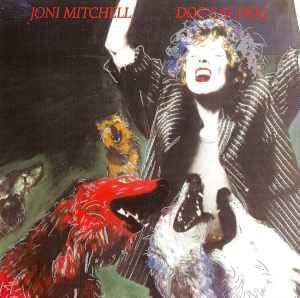
Dog Eat Dog
Biographical Memories and Observations Regarding An Album At 40. An Introduction.

Part 1: Pacific Coast Highway
It’s July 13, 1985 at about 2am. I’m with Joni and we’re driving back to Malibu on Pacific Coast Highway after finishing work at Galaxy Studios in Hollywood. It’s around closing time in Los Angeles on a Friday night and there’s quite a bit of traffic on what is one of the most dangerous stretches of highway in California.
I look forward to the left and there’s the Jonathan Club. A white Toyota comes across the center line toward us. There is a strange phenomenon that accompanies an experience like a car collision. Time slows down. Memory is stretched and becomes detailed and vivid. As the car came towards us, I quickly look to the right; there’s a car next to us. We’re boxed in. All that I can do to avoid a complete head-on collision is to slightly veer to the right.
I slam on the brakes, the Toyota doesn’t brake, and smashes into us at 40mph. The engine of our car bursts into flames. Headlights, tail-lights, broken glass, water everywhere, and blood all over my shirt. I look over and am grateful that Joan is okay. Something’s happened to my tongue. Firefighters in yellow hats, sirens wailing, an ambulance arriving, and paramedics arrive. Someone holding my forearm, guiding me into the ambulance; I’ve bitten my tongue in half. I’ve done something to my wrist. I flash on having pulled on the steering wheel like a team of horses.
The attending doctor in the emergency room is talking to me as he’s preparing to stick a needle into my tongue. “This is going to hurt”. Looking up into the lights in the OR I think “if a doctor actually says that something is going to hurt, it’s going to really hurt.
The Aftermath
The collision was massive, partially because, as we subsequently discovered, the driver of the car that smashed into us was asleep at the wheel and didn’t brake at all. Joni thankfully had crossed her arms in front of her, and a heavy bracelet that she had on her wrist protected her head from going into the windshield. Our shared perception was that the steering wheel in our car had been slightly bent, as if in the moment of impact I pulled on it hard enough to bend it in. The driver of the Toyota was drunk, and there were two young women with him, one in the passenger’s seat, and one in the back seat. The woman in the back had blood streaming down from her forehead. She had been thrown forward against the back of the front seat. The driver, drunk and asleep, wasn’t hurt.
There are times that experience seems to fall together in a cyclical nature. A day where everyone is driving badly. Every other car cuts you off. A day when you catch all of the green lights. The sequential poetry of a day can be light or dark. Sometimes events are grouped together in an allegorical way that involves things that are said, geographical locations, interactions with friends or strangers. Misunderstandings with friends or instances where communication is almost telepathic, where things are understood without even being articulated. Sometimes a combination of all of these things along with other factors. Days where everything is off-kilter or everything works right. Sometimes these days and nights are just grouped into a some kind tone; sometimes they occur in a poetic sequence that resembles a carefully crafted short story. Joni collected these, and referred to these instances as “mundane magic”. I’m not generally magically-minded, but I notice this phenomenon.
The next morning, after I had been sewn up, the nurse called us a taxi to take us back to our house in Malibu. The driver chatted as he casually drove us through the area on PCH where the collision had occurred. The glass and water has been cleared. I see the Jonathan Club come up on the left. A car suddenly veers in front of us, forcing us to swerve sharply to avoid them. We both yelled. We’ve hit some kind of dark geographical pocket that the passing of hours has not lifted? Walking into our house, I turned on the the television, and Live-Aid was in progress.
This experience; the only serious and life-threatening car wreck that I’ve ever experienced, somehow feels like a center-point in the arc of things during the making of the album of Joni’s that would be called “Dog Eat Dog”.
Dog Eat Dog
It’s November, and it’s forty years now since “Dog Eat Dog” was released. I’m going to write down some memories and recollections about this album. As we careen through The Age Of No History it seems like a worthy pursuit to write about consequential experiences that carry a weight in one’s life. History has become subject to the polarized lens of twenty-second social media posts and YouTube videos posted by “authorities”. There are many views of an experience, and our personal history is inevitably colored to some degree by the limitations of perspective, but the world that we live in now is seemingly devoid of the pursuit of verified and factual historical information.
With regard to personal memory, I love Lawrence Durrell’s “The Alexandria Quartet”, a group of 4 books, “Justine”, Balthazar”, “Clea” and “Mountolive”. Durrell said that the books are an exploration of relativity, the notion of continuum subject-object relation. Each book seems to say “you think that you understood what happened…. this is what really happened.”
I have a vivid memory of some parts of the events surrounding the making of this album. The record and it’s songs emerged from the mid-eighties, which in retrospect feel in many ways like a period that somehow foreshadowed much of the disintegration and darkness that envelop us now. Tele-evangelists sidled up to powerful politicians, selfish greed was a quality that was admired and aspired to, cocaine was omnipresent as a social engine, empathy and humility became a trivial anachronism. There was a perceptible ethos equating brutality with hipness that seemed to be reflected in politics, art and the collective language of the era. Sound familiar?